
Critical Control Assurance
Critical Control Management: From Documentation to Assurance
How connected compliance systems help organisations verify, act and improve
The updated ICMM Critical Control Management Good Practice Guide is a timely reminder for high-risk industries: critical controls do not protect people simply because they are documented.
They protect people when they are clearly defined, assigned, implemented, verified, evidenced and improved.
That distinction matters.
In mining, resources, rail, construction and other high-risk industries, organisations are often rich in procedures, registers, spreadsheets, training records, inspection checklists and audit reports. The challenge is not always whether information exists. The challenge is whether that information is connected, visible and actionable when it matters.
Critical Control Management, or CCM, helps organisations focus on the controls that matter most — the controls that prevent fatal hazards and other high-consequence events from becoming reality. The updated ICMM guide reinforces the need to move from a mindset of “identify and document” to “verify and act”, embedding critical control management into daily work, leadership routines and organisational culture.
For RSURED, this aligns closely with why connected compliance systems matter.
Compliance should not sit in isolated forms, folders and spreadsheets. It should operate as a live management system — connecting risks, controls, people, contractors, plant, training, audits, incidents, actions and leadership reporting.
Why critical controls need more than a risk register
A risk register is important, but it is only one part of the picture.
A critical control needs to answer practical operational questions:
- Are the right controls defined?
- Who owns them?
- What does good performance look like?
- Are they implemented in the field?
- Are they being verified?
- What evidence proves they are working?
- What happens when a control is missing, ineffective or overdue?
The ICMM guide highlights that severe incidents often involve known hazards where controls were missing, poorly applied or ineffective in practice. It also reinforces that critical controls must be identified, implemented and verified with the level of operating discipline their importance requires.
That is where system design becomes critical.
If risk assessments sit in one location, training records in another, audit findings in spreadsheets, plant checks in paper folders, contractor documents in email chains and corrective actions in meeting minutes, the organisation may have activity — but not assurance.
Critical control assurance requires connected evidence.
Where RSURED supports the critical control lifecycle
RSURED is designed as an integrated compliance ecosystem for high-risk industries, bringing together safety, risk, compliance, training and workforce tracking in one platform. RSURED provides real-time risk monitoring, centralised safety data, contractor oversight, mobile access and proactive safety insights.
That matters because Critical Control Management is not one standalone module or one isolated process. It relies on multiple operational systems working together.
1. Risk and Hazard Management
Critical controls begin with understanding the hazard, the unwanted event, the causes, the consequences and the controls relied upon to prevent or mitigate serious harm. RSURED’s Risk and Hazard Management capability supports this foundation by helping organisations report hazards, maintain risk registers, build bowtie-style risk assessments, assign actions and monitor control effectiveness. This gives teams a structured way to move beyond static risk documentation and create a clearer view of operational exposure.
2. Critical Control Management
RSURED’s Critical Control Management capability aligns with the core CCM lifecycle: planning the process, identifying unwanted events, identifying controls, selecting critical controls, defining performance, assigning accountability, implementing site-specific controls, verifying performance and responding to inadequate control performance. This is where organisations can bring discipline to the “critical few” — the controls that require the highest level of attention because their failure could materially increase the likelihood or severity of a serious event.
3. Audits, Assessments and Control Verification
Verification is where CCM becomes real. RSURED’s Evidence-Based Assurance module supports digital audits and assessments, recurring schedules, mobile and offline field completion, evidence capture, findings, corrective actions, workflow escalation and reporting. For critical controls, this means verification activities can be assigned, completed, evidenced and reported — not buried in paper checklists or disconnected spreadsheets.
4. Incident, Near-Miss and Learning Signals
Incidents and near misses are not just records of what went wrong. They are learning signals. RSURED’s Incident and Injury Management module supports incident and near-miss reporting, investigation, contributing factors, corrective actions, dashboards, metrics and regulator-ready reporting. When connected to risk and critical control processes, incident data can help organisations identify weak signals, recurring issues and control failures before they escalate.
5. Workforce Competency and Training
A critical control often depends on people knowing what to do, when to do it, and how to do it correctly. RSURED’s Personnel and Workforce Management module centralises employee and contractor records, roles, site assignments, CTWs, training requirements, compliance status and expiry alerts. RSURED’s Learning Management capability also supports training delivery, course assignment, inductions, SCORM content, assessments, competency compliance, renewals and reporting. This is important because control effectiveness often depends on whether the right people are trained, authorised, current and competent for the role they are performing.
6. Contractor Management
Contractors are a major part of operational risk in many high-risk industries. RSURED’s Contractor Management module supports contractor profiles, licences, prequalification, compliance registers, permissions, data sharing, automated report distribution, dashboards and compliance monitoring. For CCM, this helps ensure contractor organisations and contractor workers are not sitting outside the assurance framework. They become part of the same connected compliance system.
7. Plant and Asset Management
Many critical controls rely on plant, equipment, inspections, maintenance and authorisations. RSURED’s Plant and Asset Management module links plant records, operator authorisations, maintenance requirements, inspections, compliance obligations, plant-related risks, incidents, downtime and corrective actions. This is particularly relevant where controls depend on equipment condition, inspection cycles, authorisation to operate or evidence that plant is fit for purpose.
8. Documents, Procedures and SHMS Control
Procedures, standards and work instructions are often supporting activities for critical controls. They need to be current, approved, accessible and understood. RSURED’s HSEQ document management capability supports controlled policies, procedures, forms, safety documents, workflows, revisions, publishing, acknowledgements and links to hazards, risks, audits, incidents, CTWs and training. This helps reduce the risk of people relying on outdated documents or uncontrolled copies.
9. Corrective Actions and Continuous Improvement
A verification failure should not disappear into a report. It should trigger action. RSURED’s Business Improvement and Actions module provides a single system for non-conformances, corrective actions, improvement opportunities, complaints, audit findings, meetings, communications and action close-out. It also links actions to incidents, risks, audits, plant and documents. This supports one of the most important parts of CCM: ensuring gaps are not only identified, but owned, tracked, closed and reviewed.
The real value: connected critical control assurance
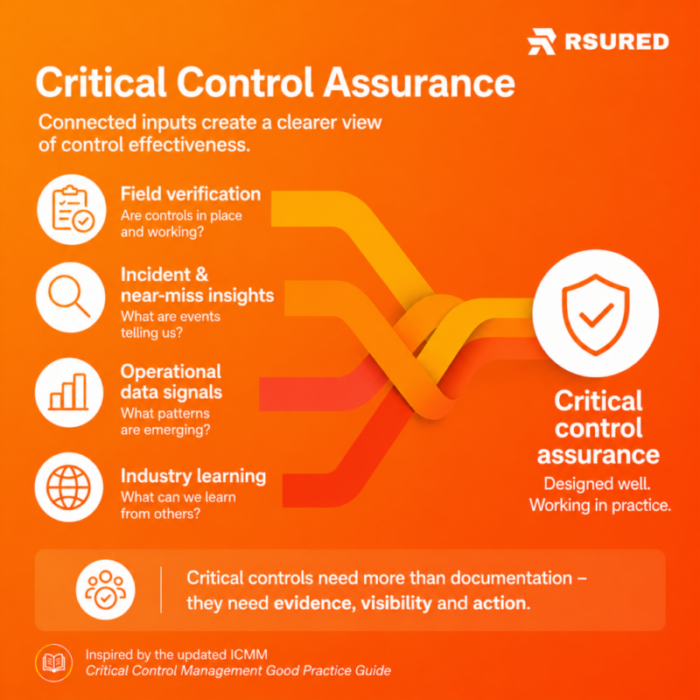
The updated ICMM guide reinforces that critical control effectiveness should be evaluated using multiple sources of information — including verification activities, incident analysis, internal information and external learning.
That is the heart of connected compliance.
A strong CCM process should not rely on one signal. It should bring together evidence from the field, operational data, incidents, audits, workforce competency, contractor status, plant condition, document control and corrective actions.
When those inputs are connected, leaders can ask better questions:
- Which critical controls are overdue for verification?
- Which sites are seeing repeated control failures?
- Which contractors are linked to recurring non-conformances?
- Which plant items are linked to incidents, overdue inspections or operator authorisation gaps?
- Which workers are assigned to roles without current competency?
- Which corrective actions are open against high-consequence risks?
- Which weak signals need escalation before a major event occurs?
This is where compliance becomes operational intelligence.
Moving from “tick and flick” to operational confidence
Critical Control Management should not become another administrative burden. Done poorly, it becomes a tick-box process. Done well, it creates a practical operating rhythm that helps protect people and strengthen decision-making.
The goal is not more paperwork.
The goal is confidence.
Confidence that the right controls are in place.
Confidence that people understand them.
Confidence that verification is happening.
Confidence that failures are visible.
Confidence that actions are being closed.
Confidence that leaders have the information they need to act.
RSURED supports this by helping organisations bring critical compliance processes into one connected system — making it easier to see what is working, what is overdue, what needs attention and what requires escalation.
Critical controls need evidence, visibility and action
The updated ICMM Critical Control Management Good Practice Guide is an important resource for the resources sector and other high-risk industries.
Its message is clear: critical controls must be more than documented. They must be implemented, verified and improved.
For organisations looking to strengthen their approach, the next step is not simply to create another register. It is to connect the systems that prove whether controls are working in practice.
That is where RSURED can help.
By connecting risk, hazards, audits, incidents, actions, contractors, personnel, training, plant and documents, RSURED helps organisations move from fragmented compliance activity to clearer critical control assurance.
Critical controls need more than documentation — they need evidence, visibility and action.
The updated ICMM Critical Control Management Good Practice Guide is available from ICMM.
Want to strengthen critical control assurance across your sites, contractors, workforce and plant? Connect with RSURED to see how integrated compliance can support your operation.