Critical Control Assurance: From Documentation to Action
Critical Control Management (CCM) is vital for high-risk industries. This article explains how connected compliance systems help organisations verify, act, and improve critical controls, moving beyond mere documentation.
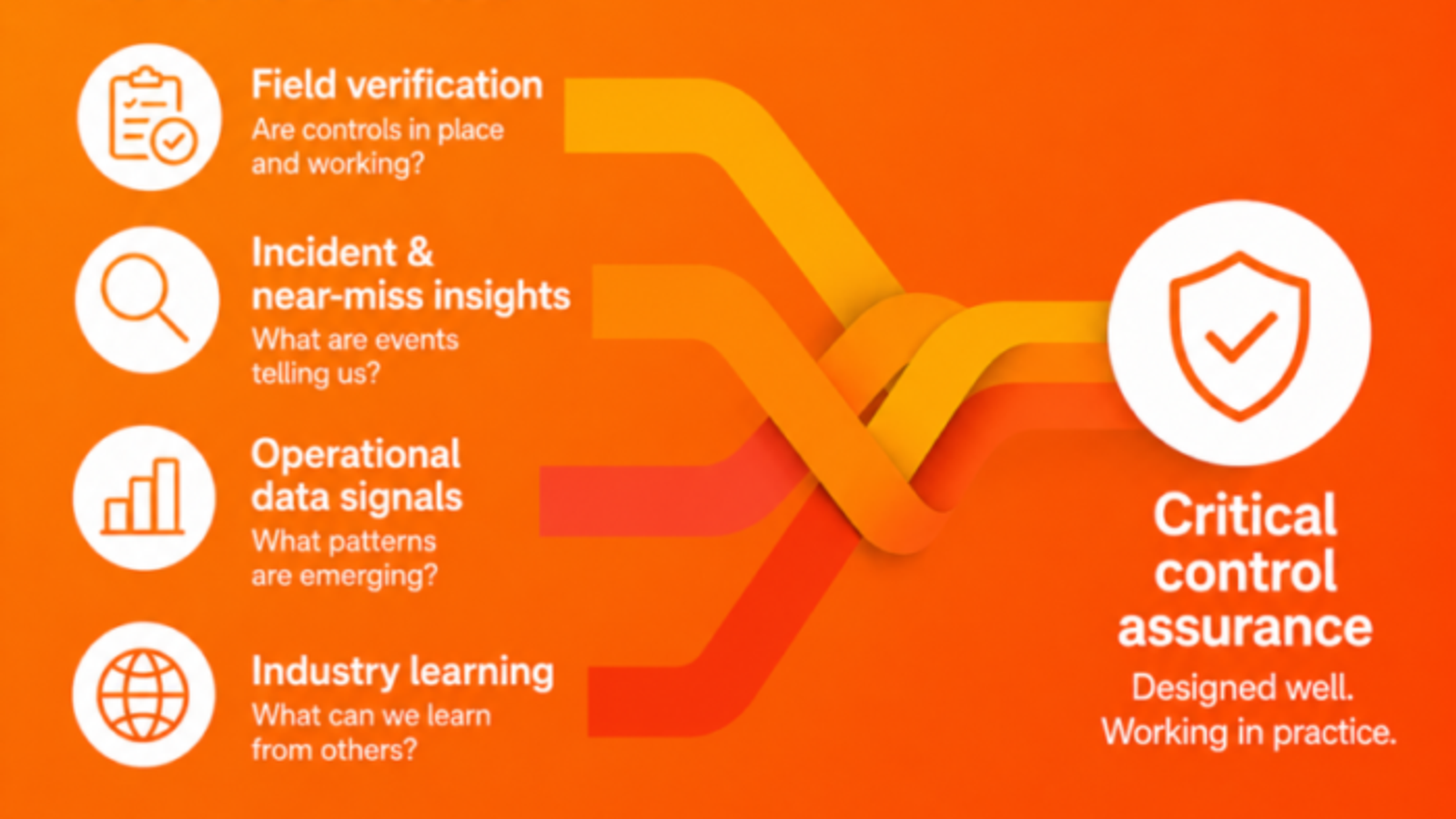
The updated ICMM Critical Control Management Good Practice Guide reminds high-risk industries that critical controls protect people when they are clearly defined, assigned, implemented, verified, evidenced, and improved—not just documented.
In mining, resources, rail, construction, and other high-risk industries, organisations often have extensive procedures, registers, spreadsheets, training records, inspection checklists, and audit reports. The challenge is not always the existence of information, but whether that information is connected, visible, and actionable when needed.
Critical Control Management (CCM) helps organisations focus on the controls that prevent fatal hazards and other high-consequence events. The ICMM guide reinforces the need to shift from an "identify and document" mindset to "verify and act," embedding CCM into daily operations, leadership routines, and organisational culture.
This aligns with how RSURED approaches connected compliance. Compliance should operate as a live management system, connecting risks, controls, people, contractors, plant, training, audits, incidents, actions, and reporting, rather than residing in isolated forms and spreadsheets.
Why Critical Controls Need More Than a Risk Register
A risk register is important, but it is only one part of the picture. A critical control needs to answer practical operational questions:
- Are the right controls defined?
- Who owns them?
- What constitutes effective performance?
- Are they implemented in the field?
- Are they being verified?
- What evidence proves their effectiveness?
- What happens when a control is missing, ineffective, or overdue?
The ICMM guide highlights that severe incidents often involve known hazards where controls were missing, poorly applied, or ineffective. It also reinforces that critical controls must be identified, implemented, and verified with the operational discipline their importance demands.
If risk assessments, training records, audit findings, plant checks, contractor documents, and corrective actions are all managed in separate systems or formats, the organisation may have activity but not assurance. Critical control assurance requires connected evidence.
How RSURED Supports the Critical Control Lifecycle
RSURED is designed as an integrated compliance platform for high-risk industries, bringing together safety, risk, compliance, training, and workforce tracking. It provides real-time risk monitoring, centralised safety data, contractor oversight, mobile access, and proactive safety insights. This is important because Critical Control Management relies on multiple operational systems working together.
Key RSURED Capabilities for CCM:
- Risk & Hazard Management: Supports reporting hazards, maintaining risk registers, building bowtie-style risk assessments, assigning actions, and monitoring control effectiveness. This moves organisations beyond static risk documentation.
- Critical Control Management: Aligns with the core CCM lifecycle: planning, identifying unwanted events and controls, selecting critical controls, defining performance, assigning accountability, implementing site-specific controls, verifying performance, and responding to inadequate control performance.
- Audits & Assessments: The Audits & Assessments module supports digital audits and assessments, recurring schedules, mobile and offline field completion, evidence capture, findings, corrective actions, workflow escalation, and reporting.
- Incidents & Injuries: Supports incident and near-miss reporting, investigation, contributing factors, corrective actions, dashboards, and metrics.
- Personnel & Workforce Management and Induction & Learning Management System: Centralises employee and contractor records, roles, site assignments, training requirements, compliance status, and expiry alerts.
- Contractor Management: Supports contractor profiles, licences, prequalification, compliance registers, and automated reporting.
- Plant & Asset Management: Links plant records, operator authorisations, maintenance requirements, inspections, compliance obligations, and plant-related risks.
- HSEQ Documents & SHMS: Supports controlled policies, procedures, forms, safety documents, workflows, revisions, publishing, and acknowledgements.
- Business Improvement & Actions: Provides a single system for non-conformances, corrective actions, improvement opportunities, and action close-out.
From Checklists to Operational Confidence
RSURED supports Critical Control Management by bringing critical compliance processes into one connected platform, making it easier to see what is working, what is overdue, what needs attention, and what requires escalation. The goal is confidence that the right controls are in place, people understand them, verification is occurring, failures are visible, actions are being closed, and leaders have the information needed to act.
Want to strengthen critical control assurance across your sites, contractors, workforce, and plant? Connect with RSURED to see how an integrated platform can support your operation.
Related RSURED modules
- Risk & Hazard Management
- Audits & Assessments
- Incidents & Injuries
- Business Improvement & Actions
- Mining industry solutions
Want to see how this connects across your sites, contractors and workforce? Book a demo with the RSURED team.